GEO for SaaS and AI tools selling overseas: a practical checklist
Citeshine helps brands find and fix what AI gets wrong about their products. We’re especially strong with SaaS and AI tools selling overseas. We test global AI engines (ChatGPT, Perplexity, Gemini) and Chinese ones (DeepSeek, Doubao, Kimi). Start with a free sample check, upgrade to the full $99 audit when you want the fix list.
This checklist is for SaaS and AI-tool teams selling to international buyers. The goal: when someone asks ChatGPT, Perplexity, Gemini or Claude (or DeepSeek, Doubao and Kimi, for Chinese-speaking buyers) “what tool should I use for X?”, your product is mentioned, described correctly, and ideally cited.
Our rule: every step should be verifiable. Where we have no public source, we label the item as our recommendation, not a fact.

Step 0: Measure a baseline (half a day)
If you change things without measuring, you will never know what worked.
- Write 10–20 questions your buyers actually ask, in three groups:
- Category questions (no brand name): “best AI tool for X”, “tools for X?”
- Comparison questions: “alternatives to [competitor]”, “[competitor] vs ?”
- Brand questions: “What is [your brand]?”, “Is [your brand] legit?”
- List 5–10 competitors and count them too.
- Run each question at least 3 times per engine. Answers vary.
- Record engine, mode (API or web, logged in or not), date, n, full answer text and cited sources.
- Read every brand answer for wrong, outdated or negative claims first, and note the source each one cites. A wrong answer costs more than a missing one.
- Use raw counts only: mention rate, position, cited domains, and whether the description is correct.
Tools: the open-source citeshine-audit (MIT; our published baseline used its ChatGPT web engine; API engines for OpenAI, Perplexity, DeepSeek, Kimi, Grok, Claude and Gemini are implemented but not yet used in a published run), a paid monitoring platform, or a spreadsheet.
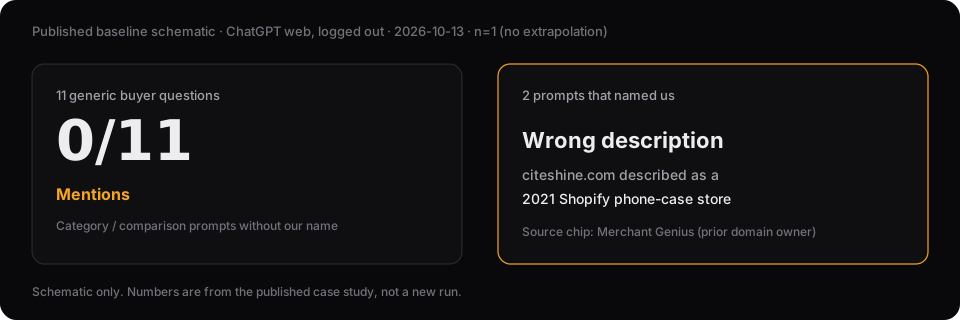
Our own baseline: on 2026-10-13, logged-out ChatGPT web, 13 prompts once each. Citeshine was mentioned in 0 of 11 generic questions. Asked by name, ChatGPT described our domain as a 2021 Shopify phone-case store. Full write-up: case study.
Step 1: Let AI crawlers in (1 day)
- Allow search crawlers in robots.txt. At minimum, check:
OAI-SearchBot: OpenAI says sites that opt out will not be shown in ChatGPT search answers (OpenAI).GPTBot(training) is a separate decision.PerplexityBot: Perplexity recommends allowing it to appear in its search results (Perplexity).Claude-SearchBot,Claude-User,ClaudeBot: Anthropic splits search, user-requested fetches and training into three bots; blocking the search bot may reduce your visibility in Claude’s search results (Anthropic).Googlebotcontrols Google Search and all its features, which include AI Overviews and AI Mode.Google-Extendedonly controls Gemini training and grounding and does not affect inclusion in Google Search (Google).Bingbot.
- Check your CDN / WAF. robots.txt can say yes while your firewall says no. Perplexity documents allow rules for Cloudflare and AWS WAF (Perplexity).
- Put key content in the HTML. Google advises making important content available in text form (Google). Our recommendation (not an official statement): don’t assume AI crawlers run JavaScript. Run
curl -A "OAI-SearchBot" https://yourdomain/and check that your product description is in the HTML. - Declare sitemap.xml in robots.txt.
- Verify the site in Google Search Console and Bing Webmaster Tools. Google says traffic from AI features is counted in the Search Console Performance report under the “Web” search type (Google).
Step 2: Tell AI who you are (1–2 days)
AI assembles its picture of you from many sources. Inconsistent or legacy information leads to wrong answers.
- Write one canonical description and use it word for word everywhere: what you are, who it’s for, what problem it solves.
- Organization JSON-LD:
name,alternateName(other-language or former names),url,logo,description,sameAs. Only list profiles that actually exist insameAs(schema.org/sameAs). Structured data should match visible page text (Google). - Check your domain’s and name’s history. Look the domain up in the Wayback Machine and search for companies with similar names. If there is a clash, say “we are not X” on your About page and in
disambiguatingDescription. - llms.txt (optional, cheap). A community proposal (llmstxt.org) for a short brand summary with links to key pages. Note that Google says you don’t need such files to appear in AI Overviews (Google), so don’t treat it as the core of GEO.
- Map your names. If you have a Chinese and an English name, state that they are the same company, with the same domain, on every profile, so AI doesn’t treat them as two companies.
Step 3: Publish content AI can quote (ongoing)
- One page per question. “What is [category]”, “How to choose a [category] tool”, “[You] vs [competitor]”, “[Competitor] alternatives”.
- Public pricing, docs and changelog. When buyers ask “how much?” or “does it support X?”, AI needs a page that answers. (Recommendation)
- Add sources, quotes and data. The GEO paper found that adding citations, quotations and statistics were among the most effective rewrites, with up to about 40% higher visibility, while keyword stuffing scored below the unoptimized baseline (Aggarwal et al., KDD 2024). The data has to be real and linked to its source.
- Keep comparison pages fair. State competitors’ strengths and your gaps, with the date you checked. One-sided comparisons are less credible. (Recommendation)
- Use real questions in FAQs. From support tickets, sales calls and community threads, not the questions you wish people asked.
- Label examples as examples. Never invent a case study. Use your own product, or clearly mark example data.
Step 4: Show up in third-party sources (ongoing)
In our 2026-10-13 test, when ChatGPT recommended GEO providers, its source chips mixed providers’ own sites with many roundups, media articles and third-party lists. In two answers listing Chinese GEO teams, every chip was a third-party media source (one sample, treat it as a hint).
- Software directories: G2, Capterra, Product Hunt, relevant awesome-lists and AI-tool directories. Complete profiles that match your site.
- Developer communities: GitHub (open-source a useful tool or SDK), Hacker News, relevant subreddits, Dev.to. Follow each community’s rules and disclose who you are.
- Chinese-language channels (for Chinese-speaking buyers and engines such as DeepSeek, Doubao and Kimi): Zhihu, Tencent Cloud Developer Community, Juejin. (Recommendation; we have no public data on these engines’ citation preferences.)
- Real reviews and case studies. Ask real users. Never buy reviews.
- Correct wrong records. If a directory or data site has outdated information about you, ask them to fix it.
Step 5: Re-test with the same ruler (every 2–4 weeks)
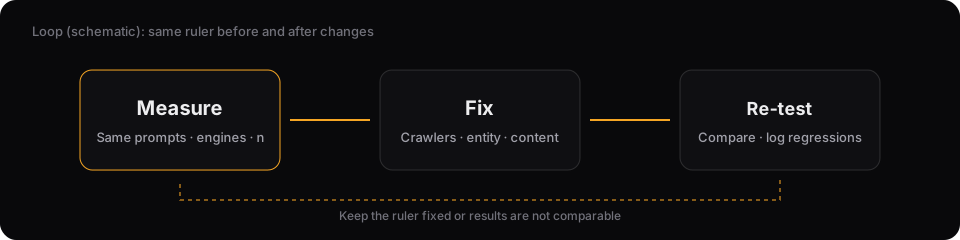
- Use the same questions, engines, mode and n. Otherwise results aren’t comparable.
- Compare mention rate, position, cited sources and accuracy, and log what you changed between runs.
- Record regressions too. Models and retrieval sources change, and one swing is not a trend.
- Watch AI referral traffic in your analytics (referrers such as chatgpt.com and perplexity.ai). Traffic from Google AI features shows up in Search Console under the “Web” search type.
Don’ts
- ✗ Buying or promising “guaranteed #1 in ChatGPT”. AI answers have no fixed ranking.
- ✗ Hiding instructions or adversarial text aimed at AI in your pages. Researchers have shown such manipulation is possible (Kumar & Lakkaraju, 2024). It erodes trust and may breach platform rules.
- ✗ Inventing clients, reviews, numbers or quotes.
- ✗ Publishing negative content about competitors (“negative GEO”).
- ✗ Treating a batch of press releases as GEO.
One-page version
| Step | Output | Time (rough) |
|---|---|---|
| 0 Baseline | Question set, raw answers, counts | Half a day |
| 1 Crawler access | robots.txt, WAF rules, readable HTML | 1 day |
| 2 Entity info | Canonical description, JSON-LD, domain-history note | 1–2 days |
| 3 Quotable content | Category pages, comparisons, FAQ, pricing, docs | Ongoing |
| 4 Third-party sources | Directories, communities, open source, real reviews | Ongoing |
| 5 Re-test | Comparison report on the same question set | Every 2–4 weeks |
Time estimates are rough guesses, not measured data.
Want someone to run Step 0 for you? Citeshine is especially strong with SaaS and AI tools selling overseas. We check global and Chinese AI engines and start with what they get wrong about you: trace each error to its source, run every prompt multiple times, and re-test on the same set after fixes. The audit is free. If we work together afterwards, you pay a monthly base fee, plus a bonus only if a re-test shows the metric reached the target we agreed on in writing: citeshine.com/audit. Get seen by AI.